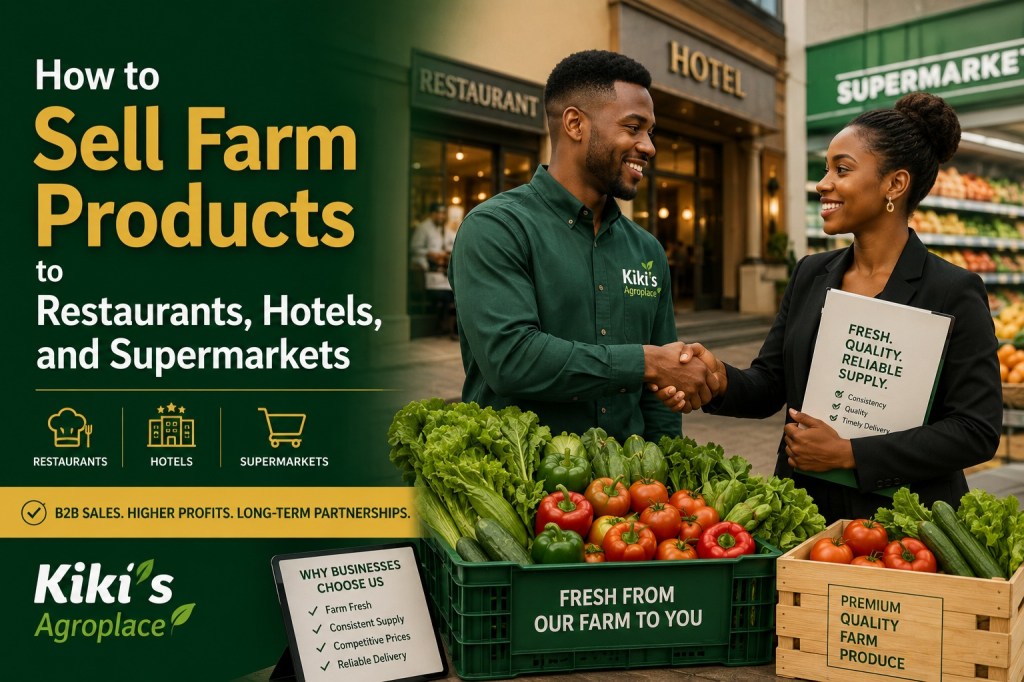
Selling farm products to restaurants, hotels, and supermarkets; what the business world calls B2B or institutional selling is one of the most reliable ways to grow your farm income. A single restaurant contract can absorb a significant portion of your weekly harvest at a fixed price. A hotel supply agreement gives you predictable order volumes months in advance. A supermarket listing puts your product in front of thousands of shoppers without you having to find each one individually.
But B2B selling in Nigeria is not the same as selling at an open market or through WhatsApp. It requires consistency, packaging, documentation, and a professional approach that most farmers are not prepared for. This guide walks you through everything you need, from preparing your farm supply chain to closing your first institutional account.
Table of Contents
- Why B2B buyers are worth pursuing
- How restaurants, hotels, and supermarkets buy differently
- What B2B buyers actually want from a farm supplier
- Step 1 — Get your farm supply-ready
- Step 2 — Identify and research your target buyers
- Step 3 — Prepare your pitch package
- Step 4 — Make contact the right way
- Step 5 — Close and manage the relationship
- Pricing for B2B wholesale
- Platforms and tools that connect farmers to institutional buyers in Nigeria
- Common mistakes farmers make when approaching B2B buyers
- Key takeaways
- FAQ
1. Why B2B Buyers Are Worth Pursuing
Selling directly to consumers through WhatsApp, Instagram, or a market stall gives you full control and direct margin. But it also means finding new buyers constantly, managing many small orders, and absorbing all the demand uncertainty yourself.
B2B buyers offer a different trade-off:
| Factor | Open Market / Direct-to-Consumer | B2B Wholesale (Restaurants, Hotels, Supermarkets) |
|---|---|---|
| Order size | Small, frequent | Large, regular |
| Price | Higher per unit | Lower per unit, but higher total |
| Buyer loyalty | Low — buyers shop around | High — buyers want stable suppliers |
| Payment terms | Cash at point of sale | 7–30 days credit terms common |
| Volume consistency | Unpredictable | Predictable once relationship is established |
| Admin burden | Low | Higher — invoices, delivery schedules, specs |
The core advantage of B2B is volume and predictability. A farm supplying five restaurants with weekly orders has more stable income than one selling the same total volume to fifty individual buyers. Once you become a reliable supplier, institutional buyer loyalty tends to be high; they need consistency and do not want to keep finding new vendors.
2. How Restaurants, Hotels, and Supermarkets Buy Differently
Each institutional buyer type has its own procurement logic. Understanding this before you approach them saves a lot of wasted effort.
Restaurants
Restaurants buy based on what their menu needs. The executive chef or kitchen manager typically makes purchasing decisions for fresh produce, proteins, and specialty items. They care most about quality, freshness, and consistency; a tomato that looks and tastes different every week creates problems in a kitchen that depends on standardised dishes. Smaller restaurants often buy more informally, while larger and upscale restaurants tend to have more structured supplier requirements.
Hotels
Hotel procurement is more formal than restaurant buying. Hotels with food and beverage departments; especially those with multiple restaurants, room service, and event catering, buy in significant volumes and usually have a procurement officer or food and beverage manager who handles supplier relationships. The approval process takes longer, but once you are an approved supplier, hotel accounts tend to be consistent and long-term. Hotels in Nigeria also often need locally-sourced ingredients for specific Nigerian cuisine offerings; a strong opportunity for local farm suppliers.
Supermarkets
Supermarkets are the most demanding institutional buyer to get into. Traditional open-air markets still account for the majority of retail food sales in Nigeria, but supermarket sales grew significantly in 2023 compared to the previous year, driven by changing consumer preferences for convenience and food safety. Getting your product on a supermarket shelf requires consistent supply, professional packaging, labelling that meets NAFDAC requirements, and in most cases a CAC-registered business. Supermarkets typically buy from distributors rather than directly from farms; so either become your own distributor, or work with an established one.
3. What B2B Buyers Actually Want From a Farm Supplier
Before you approach any institutional buyer, understand what they are actually evaluating. It is not just your product.
Consistency. This is the single most important thing. A buyer who commits to your farm as a supplier needs to know that what you deliver this week will look, taste, and be the same as what you delivered last week. Inconsistent quality; varying sizes, freshness levels, product condition, is the fastest way to lose a B2B account.
Reliability. Missing a delivery or showing up late causes real operational problems for a restaurant or hotel kitchen. Buyers who have been let down by farm suppliers before will ask about your backup plan. Have one.
Volume capacity. Can you actually supply what they need, every week, without fail? B2B buyers need to know you can meet their volume requirements consistently; not just for one delivery but across your full production cycle. Be honest about your capacity. Overpromising and underdelivering ends supplier relationships faster than anything else.
Professional presentation. This includes how your produce is packaged, how you communicate, whether you can provide invoices and delivery notes, and whether your business is registered. A farm that looks and operates like a serious business gets taken more seriously by procurement managers than one that operates entirely through WhatsApp voice notes.
Food safety. For high-end restaurants, hotels, and all supermarkets, basic food safety standards matter. This means clean handling, proper packaging, correct temperature management for perishables, and ideally NAFDAC compliance for processed products. You do not need ISO certification to supply a local restaurant, but you do need to be able to answer basic questions about how your product is handled from farm to delivery.
4. Step 1 — Get Your Farm Supply-Ready
Most farms are not ready to supply B2B buyers when they first try. The preparation work before you approach any buyer is what separates successful supplier pitches from rejections.
Register your business with CAC. Most hotels, larger restaurants, and all supermarkets require their suppliers to be registered businesses. A CAC registration also makes you eligible for a business bank account, which you need for receiving B2B payments and issuing proper invoices.
Sort, grade, and standardise your product. B2B buyers want uniformity. Before you approach any buyer, establish a grading and sorting system so that your deliveries are consistent in size, weight, and quality. For produce like mushrooms, fish, or vegetables, this means clear weight categories and rejecting substandard items before they go into delivery boxes.
Invest in proper packaging. Open market produce packed in baskets or sacks will not land a hotel contract. Invest in food-grade packaging — clean plastic crates, sealed bags, or labelled boxes — that matches the presentation standard of the buyer you are targeting. Your packaging is part of your first impression.
Build your delivery capacity. Can you transport your product to the buyer’s location reliably, on time, and in good condition? If your delivery vehicle is not reliable, arrange a logistics partner before you make any supply commitment.
Know your numbers. What is your production volume per week? What is your minimum order quantity? What is your wholesale price? What is your delivery radius? What payment terms can you offer? Know these before any buyer asks, and they will ask.
5. Step 2 — Identify and Research Your Target Buyers
Do not approach institutional buyers randomly. Identify the right targets first.
For restaurants
- Look for restaurants whose menu aligns with your product. A mushroom farm should target restaurants with continental, Asian, or upscale Nigerian menus. A catfish farm should target restaurants known for Nigerian fish dishes and pepper soup.
- Search Google Maps for restaurants in your delivery radius. Visit their menu pages. Check their Instagram to understand their food style and positioning.
- Start with mid-size restaurants; not the smallest informal bukas, not the largest five-star hotel restaurants. Mid-size operations have volume but are easier to access than large hotel chains.
For hotels
- Target hotels with food and beverage operations; those with restaurants, room service, and event catering.
- Three-star and above hotels in your region are the most viable starting targets.
- LinkedIn is useful for finding food and beverage managers at specific hotels. A direct message with a professional introduction and product offering gets a higher response rate than a cold walk-in.
For supermarkets
- Start local. Independent supermarkets and grocery chains in your city are far more accessible than national chains like Shoprite or Spar, which have formalised supplier onboarding processes.
- Research which supermarkets currently stock products similar to yours. If a supermarket already carries fresh mushrooms or smoked fish, they have a buyer for that category; approach them about adding your farm as an alternative or additional supplier.
- Register on Nigerian agricultural B2B platforms. Vendease connects food producers directly to hotels and restaurants in Nigeria. Listing your farm there puts you in front of buyers who are already looking for suppliers.
6. Step 3 — Prepare Your Pitch Package
Walking into a restaurant kitchen or calling a hotel procurement office empty-handed is a wasted opportunity. Prepare these before you make any approach.
Product specification sheet. A one-page document covering: what you produce (product name, variety, description), available quantities per week, packaging options and sizes, delivery locations and frequency, price list (wholesale, per kg or per unit), minimum order quantity, and contact details with your business registration number.
Samples. Always bring product samples to your first meeting with a restaurant chef or hotel buyer. No buyer commits to a supply relationship without tasting and evaluating what you are offering. Your samples should represent exactly what you deliver — not the best items from your best harvest.
Photos and social proof. A short portfolio of your farm — photos of your growing operation, your harvesting process, your packaging, and any existing satisfied buyers — builds confidence. If you already supply other restaurants or businesses, say so. Name them if they are willing to be referenced.
Delivery and payment terms document. A simple one-page outline of how you work: delivery days, payment terms, minimum order, cancellation notice period, and contact details for orders and queries. This signals that you operate professionally and have thought through the logistics.
7. Step 4 — Make Contact the Right Way
Cold calling and visiting
For restaurants, the best approach is a direct visit during off-peak hours — not during lunch or dinner service — with samples in hand. Ask to speak with the chef or kitchen manager. Keep your introduction short: who you are, what you farm, why you are approaching them specifically, and what you want — a 10-minute conversation and the chance to leave samples. Do not pitch on the spot. Let the samples do the work.
For hotels, call ahead and ask for the food and beverage manager or procurement department. Request a brief meeting rather than trying to pitch over the phone. Follow up with an email that includes your product spec sheet.
LinkedIn outreach
Search for procurement managers, chefs, and food and beverage directors at your target hotels and larger restaurants on LinkedIn. A short, specific message — referencing their establishment, what you produce, and what you are offering — gets a higher response rate than a generic pitch.
Referrals
The most effective route into B2B accounts is a referral from someone who already supplies or works with the buyer. Every existing B2B relationship you build is a potential introduction to three more. After every successful supply relationship, ask your buyer directly: “Is there another kitchen manager or procurement officer in your network who might benefit from what we offer?”
B2B agri-platforms
Register your farm on Nigerian agricultural B2B platforms and procurement networks. Vendease in Nigeria and Afrikamart in Senegal are examples of platforms specifically designed to connect farms and food producers directly to hospitality businesses and processors. Being listed means buyers can find you without cold outreach on your part.
8. Step 5 — Close and Manage the Relationship
Start with a trial order. Propose a small initial supply — enough for the buyer to evaluate your product in their kitchen without making a large commitment. A chef who has cooked with your mushrooms or catfish once is far more likely to sign a regular supply agreement than one who has only seen your samples.
Follow up within 48 hours. After the trial, contact the buyer directly. Ask for feedback. Was the quality what they expected? Was the delivery on time and in good condition? What would they change? Buyers who give you feedback are telling you exactly what you need to do to keep the account.
Be proactive about supply issues. If a harvest is delayed, your vehicle breaks down, or you cannot meet an order volume this week — call the buyer before delivery day, not on it. Buyers can manage around notice. They cannot manage around surprises.
Invoice correctly and promptly. Send invoices immediately after each delivery. Include your business name, bank details, invoice number, delivery date, items supplied, quantities, and total amount. Keep copies of all invoices. B2B buyers with payment terms of 7 to 30 days need an invoice in hand to process payment — if you do not send one, payment is delayed.
Review the relationship quarterly. Every three months, have a brief conversation with your key B2B accounts. What are they planning for the next season? Are there new menu items coming that require different products? Are there volume changes you should plan for? Buyers who feel like they have a genuine supply partner — not just a vendor — stay with you longer.
9. Pricing for B2B Wholesale
B2B wholesale pricing is lower per unit than direct-to-consumer pricing — but that is offset by the volume, the predictability, and the lower cost of sales. Here is a framework.
- Calculate your cost of production per unit. Include inputs (seed, feed, substrate, chemicals), labour, packaging, transport, and a proportion of your fixed costs (rent, equipment depreciation).
- Add your wholesale margin. For most Nigerian farm products, a wholesale margin of 20% to 35% above cost of production is reasonable. This is lower than retail margins but reflects the lower cost of acquiring and retaining a B2B buyer.
- Check market rates. Know what competing suppliers are offering the same buyer. You do not need to undercut — but your pricing needs to be in range. A premium above market rate is only sustainable if you can clearly justify it with superior quality, more reliable delivery, or better packaging.
- Build in delivery costs. If you are delivering, build the delivery cost into your price or charge it separately as a delivery fee. Do not absorb delivery costs silently — it erodes your margin over time.
- Set minimum order quantities. Small orders are not worth delivering. Set a minimum order quantity that makes the delivery economical for you.
10. Platforms and Tools That Connect Farmers to Institutional Buyers in Nigeria
| Platform / Channel | What It Does | Best For |
|---|---|---|
| Vendease | Procurement platform connecting food producers to restaurants and hotels | Restaurants, hotels |
| Agromart | Online agri-marketplace for farm produce | Retailers, processors |
| Afrimash | Agricultural marketplace with B2B functionality | Various buyer types |
| Direct outreach to procurement managers and chefs | Hotels, corporate catering | |
| Food & Beverage West Africa trade show | Annual Lagos event for food producers and buyers | Supermarkets, large hospitality groups |
| WhatsApp Business | Direct communication with individual buyers | All buyer types |
| Your own blog and SEO | Buyers searching for local suppliers find you online | Inbound leads across all segments |
11. Common Mistakes Farmers Make When Approaching B2B Buyers
Approaching without samples. No institutional buyer commits without tasting and evaluating your product first. Always bring samples — and make sure they represent your typical delivery standard, not your best-ever harvest.
Inconsistent supply after landing the account. This is the most common reason farm supplier relationships end. Landing a restaurant account with a great first delivery and then failing to maintain that quality or reliability is worse than never landing the account — it damages your reputation in the buyer’s network.
Underpricing to win the contract. Pricing below your sustainable margin to beat a competitor gets you the account but erodes your income over time. Price at a margin you can sustain and compete on quality, reliability, and service instead.
Not having a CAC registration. Hotels and supermarkets specifically will not onboard unregistered suppliers. Get your business registered before you approach formal institutional buyers.
Treating B2B buyers like retail customers. B2B buyers are not browsing. They are making procurement decisions that affect their kitchen operations. Communicate professionally, deliver on time, invoice correctly, and respond to queries promptly. The relationship norms are different from consumer selling.
12. Key Takeaways
- B2B selling to restaurants, hotels, and supermarkets offers volume, predictability, and loyalty that direct consumer selling rarely provides.
- Each buyer type — restaurant, hotel, supermarket — has different procurement processes and requirements. Research and approach them differently.
- Consistency and reliability matter more than price. A buyer who can depend on your farm every week will stay with you even if a cheaper competitor appears.
- Prepare before you pitch: CAC registration, standardised product, professional packaging, a spec sheet, samples, and delivery capacity.
- Start with mid-size restaurants and independent supermarkets. Build a track record before approaching large hotel chains or national retail chains.
- Price at a margin you can sustain — not at a price that wins the contract but kills your income. Build delivery costs into your pricing.
- Use platforms like Vendease and Afrimash to get inbound B2B leads without cold outreach.
- Manage the relationship after you land it. Proactive communication, correct invoicing, and quarterly reviews are what keep B2B accounts long-term.
Need to price your farm products correctly for both retail and wholesale? Read our guide on how to price your farm products for profit.
Want to build a customer base before approaching B2B buyers? Read our guide on how to build a customer base for your agribusiness from zero.
Looking to add value to your produce before pitching to institutional buyers? Read our guide on how to add value to your farm products.
13. FAQ
What does B2B mean in farming?
B2B stands for business-to-business. In farming, it refers to selling your produce directly to businesses — restaurants, hotels, supermarkets, food processors, corporate canteens — rather than to individual consumers. B2B sales typically involve larger order volumes, formal supply agreements, and payment terms rather than cash at point of sale.
How do I find restaurants to sell my farm products to in Nigeria?
Start by identifying restaurants in your delivery radius whose menu aligns with your product. Search Google Maps and Instagram for relevant restaurants. Visit during off-peak hours with samples. You can also list your farm on procurement platforms like Vendease, which connects food producers directly to hotels and restaurants in Nigeria.
What do supermarkets require from farm suppliers in Nigeria?
Supermarkets typically require a CAC-registered business, consistent and professionally packaged product, NAFDAC compliance for processed goods, the ability to supply agreed volumes weekly, and proper invoicing. National chains like Shoprite and Spar have formalised supplier onboarding — start with independent supermarkets before approaching these.
How should I price my farm products for wholesale?
Calculate your cost of production per unit, add a margin of 20% to 35%, check competitor pricing, and build in delivery costs. Set minimum order quantities that make each delivery economical. Do not undercut your margin to win contracts — price at a level you can sustain.
How do I maintain a B2B supply relationship once I land it?
Deliver on time, maintain consistent product quality, invoice promptly, and communicate proactively about any supply issues before delivery day; not on it. Check in with your buyer every three months to understand their changing needs. B2B relationships that last are built on reliability, not just on price.


Leave a Reply