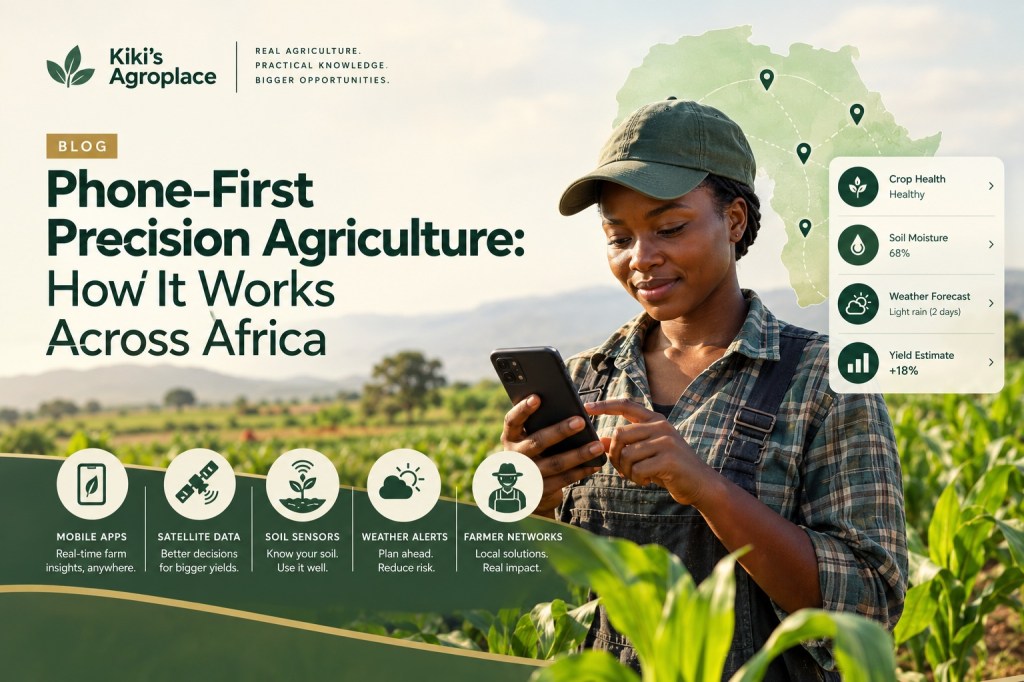
Phone-first precision agriculture (using data and technology to farm more exactly, delivered through a basic mobile phone instead of expensive equipment) is the part of this shift doing the most work right now. It doesn’t need a farmer to own a smartphone, a computer, or any hardware at all. It just needs a phone number.
This post breaks down the four tools actually doing this at scale across Africa: SMS weather forecasts, satellite-triggered insurance, mobile soil testing referrals, and pay-as-you-go input and equipment access. Each one moves satellite and machine-learning work off the farmer’s shoulders and onto a phone screen.
SMS weather forecasting
Weather forecasting near the equator is a harder problem than most people realise. Global forecasting models (the computer programs that predict weather for most of the world) are built and tested mainly on data from temperate countries (places with four distinct seasons, like the UK or the US). Applied directly to tropical regions, those models perform poorly; some studies put their accuracy below 40% in West Africa.
Ignitia, a company working across West Africa, built a forecasting model from scratch for the tropics instead of adapting a temperate one. It sends two-day, monthly, and seasonal rain forecasts by text message, priced at a few cents per forecast, paid through ordinary phone credit. Farmers use it to time planting, fertilizer application, and harvesting around the rain rather than guessing.
The advisory itself is built on satellite data and machine learning; the same underlying technology used in expensive Western farm-sensor systems. The farmer never sees any of that. They see a text message.
Satellite-triggered index insurance
Traditional crop insurance needs an assessor to visit a farm after damage happens, check the loss, and calculate a payout. For a smallholder farm (a small farm, usually under two hectares, run by a family) worth a few hundred dollars a season, that visit costs more than the insurance itself makes sense to offer. For decades, this made crop insurance for smallholders essentially unavailable.
Index insurance (insurance that pays out automatically based on measured conditions, like rainfall or satellite-tracked crop health, instead of an individual farm inspection) solves this. A company sets a threshold; say, rainfall dropping below a set level in a given area during the growing season. Satellites track whether that threshold is crossed. If it is, every insured farmer in that area gets paid, automatically, with no inspector involved.
Pula, working across 17 countries, has reached over 4.7 million farmers this way. The insurance is often bundled directly into the cost of seeds or fertilizer, so a farmer buying inputs is automatically covered without a separate purchase decision.
This same satellite-based model works for livestock, not just crops — insuring herders against drought using tracked grazing conditions instead of counting individual animal deaths. See our guide to livestock insurance in Africa for how this works in practice.
Mobile soil testing referrals
Soil testing tells a farmer exactly what their land is missing; nitrogen, phosphorus, the right pH balance, instead of applying fertilizer by guesswork. A full lab soil test has always existed in Africa. The problem was never the science. It was distance: a farmer several hours from a testing lab, with no easy way to send a sample or get a result back in time to act on it.
Mobile-based referral services close that gap. A local agent visits the farm, takes a sample using a handheld sensor or collects it for lab processing, and results are sent back to the farmer’s phone; often with a specific fertilizer recommendation attached, not just raw numbers the farmer has to interpret alone. Apollo Agriculture folds this kind of soil assessment directly into its input packages, using it to decide exactly which fertilizer blend a specific farmer’s plot needs.
Pay-as-you-go inputs and equipment
Buying a tractor outright makes no sense for a farmer working one or two hectares; the machine would sit idle most of the year. Buying a full season of fertilizer and seed upfront is often impossible without credit most smallholders can’t access through a bank.
Two models have grown to solve this, both running through a phone:
- Equipment-sharing: Hello Tractor connects farmers to nearby tractor owners through a phone app, working like a ride-hailing app but for farm machinery. The farmer pays only for the hours or hectares they use. The company has reached over 1 million smallholders across 18 countries this way.
- Bundled credit: Apollo Agriculture uses satellite data and a farmer’s own track record to decide who qualifies for seed and fertilizer on credit, repaid after harvest instead of paid upfront. This turns a cash-flow problem; needing money before the money-making season starts; into a repayment problem, which is far easier for a smallholder to manage.
Neither model needs the farmer to save up capital before starting the season. Both spread the cost against the harvest that’s coming, not the one that already happened.
The phone in the household isn’t always the farmer’s
Every tool in this post assumes a simple thing: that the person farming the land is the person holding the phone. Across Africa, that’s often not true. Women make up roughly half of the agricultural workforce, but only around 25% of registered users of digital agriculture services are women and real usage gaps run wider still. In a 2022 GSMA survey across 12 African countries, women working in agriculture were between 5% and 40% less likely than men to own a mobile phone at all, depending on the country.
This gap shows up even inside services built specifically to help. M-Kilimo, the Kenyan farmer helpline covered in our piece on data ownership and hype, had a user base that was 31% women — but only 19% of its regularly active users were women, meaning the gap widened once a tool was actually in use, not just signed up for. A Tanzania study found a similar pattern at the household level: almost all men surveyed used their own privately-owned phone for farm decisions, compared to only two-thirds of women. The reasons repeat across studies: women are less likely to own the phone in a household, less likely to be treated as its primary user even when they do, and less likely to have the literacy or confidence that a mostly male-designed service assumes.
Some companies are addressing this directly rather than treating it as background noise. Several agritech firms have started building female-only agent networks; local women who sign up and support other women farmers, rather than routing everyone through a mostly male sales and support team. Field research points to a specific reason this helps: women farmers are more comfortable asking questions and giving honest feedback to another woman, especially on money matters, than to a male agent they’ve just met. The gap is worth closing beyond fairness alone. The UN Food and Agriculture Organization estimates that if women farmers had the same access to resources as men, their yields could rise by 20 to 30% a gain large enough to lift total agricultural output across developing countries by several percentage points.
Why this matters more than it looks like it does
None of these four tools look like “precision agriculture” the way it’s usually pictured; no drone, no tractor, no sensor in the ground. But every one of them does the same job precision agriculture is supposed to do: replace guesswork with data, at the exact moment a farmer needs to make a decision.
The difference is where the expensive part sits. In the Western model, the expensive technology sits on the farm. In the African model, it sits with the company; Ignitia’s forecasting servers, Pula’s satellite monitoring, Apollo’s machine learning — and the farmer only ever touches the cheap, simple end of it: a text message, a phone call, a repayment plan.
A newer layer is being added on top of these four tools right now: AI chatbots and disease-diagnosis apps that put an even more direct advisory role into a farmer’s hands, covered in our piece on AI in African agriculture.
Key takeaways
- Phone-first precision agriculture runs on SMS and basic phone apps, not smartphones or on-farm sensors.
- SMS weather forecasts, satellite insurance, mobile soil testing, and pay-as-you-go credit are the four tools doing this at real scale today.
- The expensive technology; satellites, machine learning, sits with the company, not the farmer.
- Only around 25% of registered digital agriculture users in Africa are women, and the gap widens further among active users; most of these tools were built assuming the phone-holder and the farmer are the same person.
- Female-only agent networks are one proven way agritech companies are closing that gap, and the FAO estimates closing it fully could raise women’s yields by 20 to 30%.
- This isn’t a smaller version of precision agriculture. It’s the same goal, reached through a cheaper delivery method built for the farms that actually exist here.
Frequently asked questions
Do I need a smartphone for any of these tools?
No. SMS weather forecasts, index insurance payouts, and equipment-booking through Hello Tractor all work on a basic phone. A smartphone helps with some apps but isn’t required for the core service.
How much does satellite-based crop insurance cost?
It’s usually bundled into the price of seeds or fertilizer rather than sold separately, so the exact cost depends on the input package. It’s designed to be affordable at smallholder scale — Pula’s model, for example, reaches millions of farmers with premiums low enough to bundle into everyday input purchases.
Is pay-as-you-go credit the same as a loan?
It works similarly — inputs now, repayment after harvest — but it’s usually arranged through the input provider directly rather than a bank, and approval is based on farm and satellite data rather than a credit history.
Are women farmers less able to use these tools?
No — the technology works the same regardless of who uses it. The gap comes from access and design, not ability: fewer women own or control the household phone, and many services were built without female users specifically in mind. Companies that address this directly, for example through female agent networks, generally see strong uptake from women once that access barrier is removed.
Kiki’s Agroplace: Bridging the knowledge gap in agriculture.


Leave a Reply