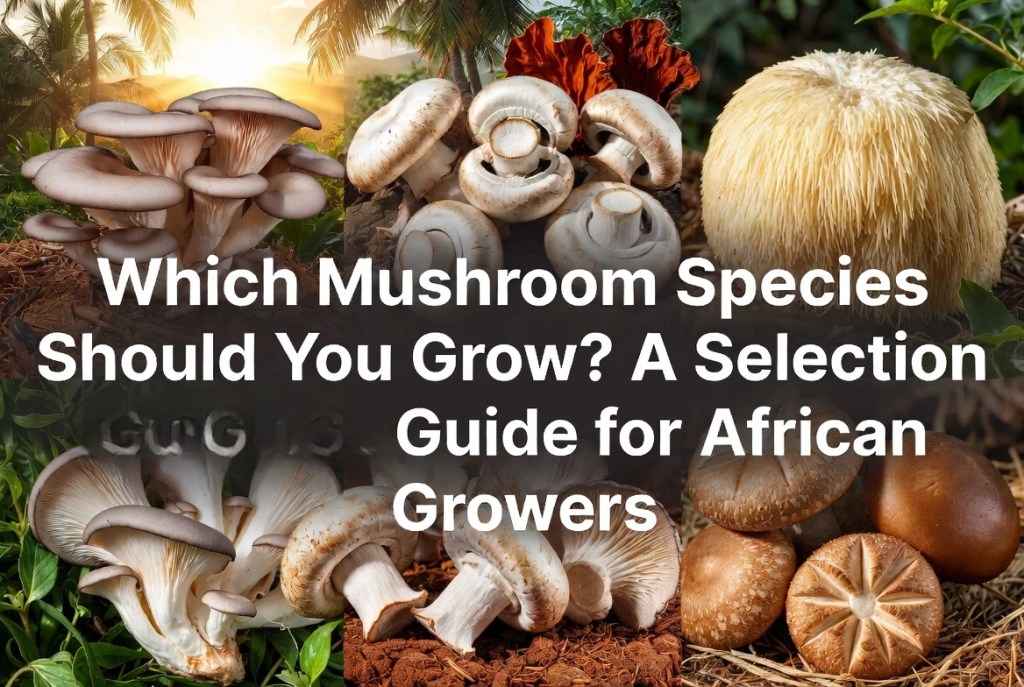
Choosing which mushroom species to grow matters as much as choosing your growing method. Get the species wrong for your climate, and no amount of skill fixes that. This guide covers what each major species actually needs, what’s best to grow across most of Africa right now, and what to approach with real caution.
Species at a Glance
| Species | Climate fit (tropical Africa) | Main market | Difficulty |
|---|---|---|---|
| Oyster | Excellent — no cooling needed | Broad culinary | Easiest |
| Button | Good, with a bulk room setup | Broad culinary | Moderate |
| Reishi | Excellent — thrives in tropical heat | Wellness/supplement | Moderate |
| Lion’s mane | Good, with a cooling step | Culinary + wellness | Moderate |
| Shiitake | Good, with a warm-weather strain | Culinary (mainly) | Moderate |
| Maitake | Unproven in tropical setups | Culinary + wellness | Hard |
| Enoki | Difficult — needs sustained cold, not just a brief shock | Culinary | Hard |
The Reliable Starting Points
Oyster mushrooms are the easiest species to start with anywhere in Africa. They grow on straw or sawdust, need no casing, tolerate tropical heat without extra cooling, and reach harvest faster than any other species here. See our oyster mushroom farming guide.
Button mushrooms need a compost-based process and a bulk room for pasteurization; more setup than oyster, but they sell into the widest, most familiar market. Full process: compost guide and bulk room setup.
Reishi is one of the most underrated options for this climate; it fruits well at 25-30°C, meaning tropical heat works in your favour instead of against you. It targets the wellness and supplement market rather than the kitchen. See our medicinal mushroom species guide.
Viable, But They Need a Cooling Plan
Lion’s mane and shiitake both need a temperature drop to trigger fruiting, which matters in a hot climate. This isn’t a deal breaker; evaporative cooling and, for shiitake, warm-weather strains make both genuinely workable, but it means budgeting for that step rather than skipping it. Full guides: lion’s mane cultivation and shiitake cultivation.
Species to Approach With Caution
Maitake needs a cold snap to fruit properly, similar to shiitake, but there’s little documented success growing it in tropical setups so far. Treat it as one to watch, not one to build a business plan around yet.
Enoki is a harder case than lion’s mane or shiitake. It doesn’t just need a brief cold shock to start fruiting; it needs sustained temperatures as low as 4-13°C (40-55°F) for the entire fruiting period to get the long, thin “golden needle” form buyers expect. That’s an actual, ongoing refrigeration commitment, not a one-time workaround. Unless you have reliable access to cold storage or a refrigerated room, this isn’t a realistic first species to grow in most of tropical Africa.
Method Matters Too, Not Just Species
Picking a species is only half the decision. Button mushrooms and everything else on this list use fundamentally different growing methods; compost versus substrate. See our compost vs. substrate guide to work out which method fits your materials and setup before you commit to a species.
Key Takeaways
- Oyster mushrooms are the most forgiving starting point across nearly all of Africa’s climate range.
- Reishi is an underused option; tropical heat actually works in its favor.
- Lion’s mane and shiitake are viable, but only with a real cooling plan built in from the start.
- Maitake and enoki both need sustained cold that most tropical setups can’t provide affordably yet; treat them as advanced or future options, not starting points.
- Species and growing methods are two separate decisions; check both before making a commitment.
FAQ
What’s the easiest mushroom species to grow in Africa?
Oyster mushrooms. They tolerate tropical heat without special cooling and grow on simple, widely available substrate.
Can enoki mushrooms be grown in a hot climate at all?
Only with reliable, sustained refrigeration through the entire fruiting stage, not just a brief cold shock. For most growers without that infrastructure, it isn’t a practical first choice.
Should I pick my species or my growing method first?
Check both together. Some species only work with one method; button mushrooms need compost, for example, while oyster and lion’s mane use substrate. See our compost vs. substrate guide for that side of the decision.
Kiki’s Agroplace: Bridging the knowledge gap in agriculture.


Leave a Reply