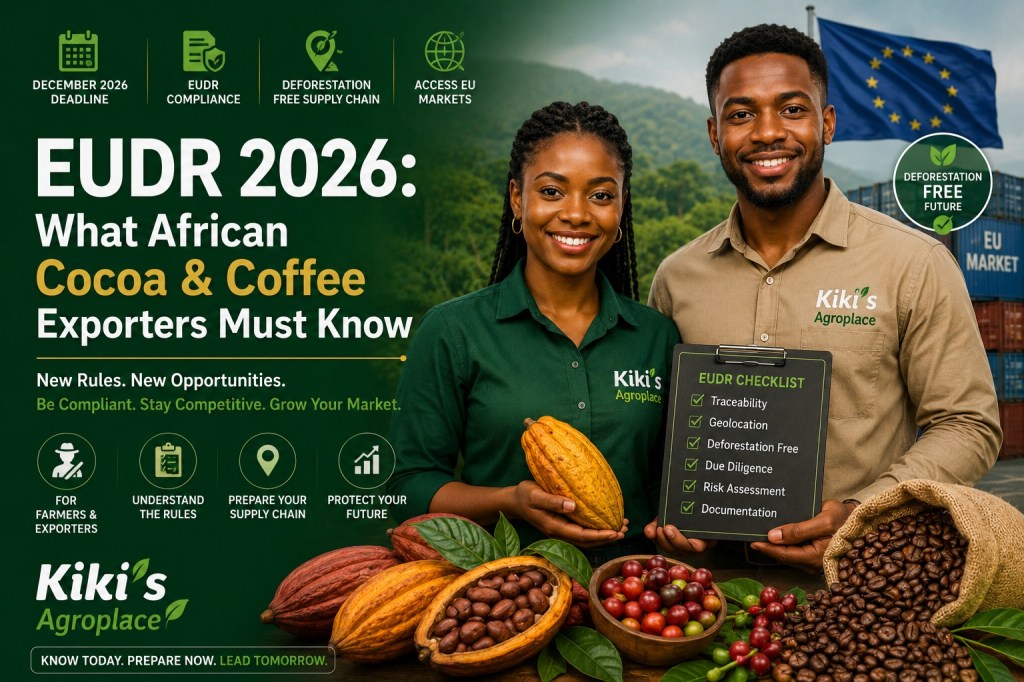
A new EU rule called EUDR is about to change how African cocoa and coffee reach European buyers. If you export cocoa, coffee, palm oil, rubber, soy, cattle products, or wood to Europe, this rule affects you directly. Here’s what EUDR means, who it hits hardest, and what you need to do before the deadline.
What is EUDR?
EUDR stands for EU Deforestation Regulation. It’s a European law with one simple goal: stop deforestation-linked goods from entering the EU market.
Under EUDR, any covered product sold in or exported to the EU must meet three conditions:
- The land it came from was not cleared of forest after December 31, 2020.
- It was grown or produced following the laws of its home country.
- It comes with a due diligence statement: a document proving the first two points are true.
A due diligence statement is just paperwork. It shows exactly which plot of land your product came from, using GPS coordinates, plus proof that plot wasn’t deforested.
How to export farm products from Nigeria Beginners’ Guide
Which products does EUDR cover?
| Commodity | Examples of covered products |
| Cocoa | Cocoa beans, cocoa powder, chocolate |
| Coffee | Green beans, roasted coffee, instant coffee |
| Palm oil | Crude palm oil and palm oil derivatives |
| Rubber | Natural rubber, tyres |
| Soy | Soybeans, soybean oil |
| Cattle | Beef, leather |
| Wood | Timber, paper, furniture |
Printed items like books and newspapers were removed from the list in late 2025. Everything else on this table still applies.
Key dates for EUDR
| Date | What it means |
| December 31, 2020 | The cutoff date. Land cleared after this date does not count as deforestation-free. |
| December 30, 2026 | Large and medium companies must fully comply. |
| June 30, 2027 | Small and very small companies get an extra six months. |
EUDR has already been delayed twice, first from 2024 to 2025, then from 2025 to 2026. As of mid-2026, the European Commission has confirmed there will be no further delay. Plan around these dates as fixed.
How to package and brand farm products to sell at higher rates
Big company or small farmer — the rules differ
EUDR doesn’t treat every business the same way. Your farm size and role in the chain change what you actually need to do.
| Your role | What you need to do |
| Large or medium exporter/importer | Full due diligence statement, submitted for each shipment, with GPS data for every plot |
| Small or micro farmer | A simpler one-time declaration, or just providing GPS data to your buyer or cooperative |
| Farm plot under 4 hectares | One GPS point is enough |
| Farm plot over 4 hectares | A full outline of the farm (called a polygon) is needed |
Why this hits African cocoa and coffee hard
Two African sectors face the biggest impact.
Cocoa. Côte d’Ivoire and Ghana grow around 60% of the world’s cocoa. Most of it comes from smallholder farms, not large plantations. That makes plot-level tracking harder and slower to set up.
Coffee. East African coffee: from Ethiopia, Uganda, Kenya, Rwanda, Tanzania, Burundi, Cameroon, and the DRC, faces the same problem. A single export container often holds beans from hundreds of small farms. Each one needs a GPS record.
Europe buys most of Africa’s coffee and a large share of its cocoa. Losing that market isn’t a small setback; it’s the loss of your biggest buyer.
Finding buyers and distributors abroad for agricultural exports
A 2025 survey by Rainforest Alliance found most smallholder cocoa farmers hadn’t heard of EUDR, or thought it only applied to large farms. If you’re reading this, you’re already ahead of most of your peers.
How to trade across African borders in 2026
Common myths about EUDR
Myth: “I’m a small farmer, so I have to handle all this paperwork myself.”
Reality: most EUDR paperwork sits with the company that first places your product on the EU market; usually, your buyer or exporter, not you. Your part is smaller: sharing accurate location data for your farm.
Myth: “I need a formal land title to prove where my crop came from.”
Reality: if your country’s law doesn’t require a land title to grow and sell crops, you don’t need one for EUDR either. You still need to show your plot’s location and that it wasn’t deforested after 2020.
Myth: “My country will get banned from selling to the EU.”
Reality: no country or product is banned under EUDR. Any country can keep selling to the EU, as long as the due diligence proof is in place.
Export documentation basics for agricultural products.
If you’re a smallholder farmer, here’s your part
You don’t need to become a compliance expert. Focus on these:
- Get the GPS location of your farm; a single point if it’s under 4 hectares, a full outline if it’s larger.
- Check if your cooperative already collects this data. Many now do this for all members at once.
- Ask your buyer directly if they need anything extra from you.
- Keep a record of your GPS data and any paperwork for at least five years.
The good news: rules got lighter for small farmers
The EU listened to complaints from smallholder-heavy countries and eased some requirements in late 2025:
- Only the first company that places your product on the EU market has to file the full due diligence statement. Buyers further down the chain have lighter paperwork.
- Small and very small farmers can file a one-time simplified declaration instead of a full statement.
- Cooperatives can choose to submit one grouped statement covering all their member farms, instead of one statement per farmer. This is optional, not required.
That last point matters most for coffee and cocoa cooperatives. It turns a huge paperwork job into one shared task.
What’s already working:
Some African exporters are already ahead of the deadline.
In Rwanda, an EU coffee importer worked with a local trading company to ship the country’s first fully EUDR-compliant coffee container in late 2025. It proved the system works end to end, not just on paper.
In Cameroon, six major coffee exporters built a shared platform to pool farm GPS data. Smaller, verified exporters can tap into that data instead of collecting it all themselves.
Both examples point to the same lesson: exporters who move early, and who share the work through cooperatives or shared platforms, get ahead of exporters who wait. Some EU buyers are already telling suppliers they want proof of compliance well before the official deadline. Waiting until the last month is a risk to your buyer relationship, not just your paperwork.
Steps to take now
- Map your supply chain. List every farm or plot your cocoa or coffee comes from.
- Collect GPS coordinates for each plot, or find out if your buyer’s cooperative already has a shared data system.
- Check your farm size category. Micro and small farms qualify for the simplified declaration; full due diligence is not always required.
- Talk to your buyer. Ask if they already run a grouped due diligence system you can join.
- Set a paperwork deadline for yourself well before December 2026. Systems can be slow to test in the final months before a deadline.
FAQ
Does EUDR apply to me if I sell to a middleman, not directly to the EU?
Yes, if your product ends up in the EU. The paperwork burden is usually heavier on the party that first places the product on the EU market; often, this is your buyer, not you. But you still need to provide accurate farm data for that paperwork to be correct.
What happens if I don’t comply?
Non-compliant products can be blocked from entering the EU market. For exporters, that means losing access to European buyers.
Is EUDR going to be delayed again?
As of mid-2026, the European Commission has said no further delay is planned. Treat December 2026 as fixed.
Do I need a formal land title to comply with EUDR?
No. If your country’s law doesn’t require a land title to grow and sell your crop, EUDR doesn’t require one either. You still need to prove the plot’s location and that it wasn’t deforested after December 2020.
Does my farm need a full boundary map, or just one point?
It depends on size. Farms under 4 hectares only need a single GPS point. Farms over 4 hectares need a full outline of the land, called a polygon.
Can a certification like Rainforest Alliance or Fairtrade help me comply?
Yes, it can reduce some of the extra work. But certification alone doesn’t replace the need to share your farm’s location data; think of it as a helpful shortcut, not a full substitute.
My cooperative already collects farmer data, do I need to do anything separately?
Probably not much. Ask your cooperative directly if your farm’s GPS data is already on file. Many cooperatives now collect this once for all members, instead of farmer by farmer.
Key takeaways
- EUDR requires proof that cocoa, coffee, and five other commodities are deforestation-free before they can enter the EU.
- Large exporters must comply by December 30, 2026. Small farmers get until June 30, 2027.
- Farm size decides how much proof you need: a single GPS point under 4 hectares, a full outline above it.
- Most of the paperwork burden sits with your buyer, not with you as a farmer.
- Cooperatives can share the paperwork load through grouped declarations: this is optional but saves time.
- Rwanda and Cameroon already have working examples other exporters can learn from.
- Start mapping your supply chain now. Waiting until late 2026 leaves no room for delays.
Need help figuring out where your farm or cooperative stands on EUDR? Get in touch for a free digital marketing and export readiness chat.


Leave a Reply