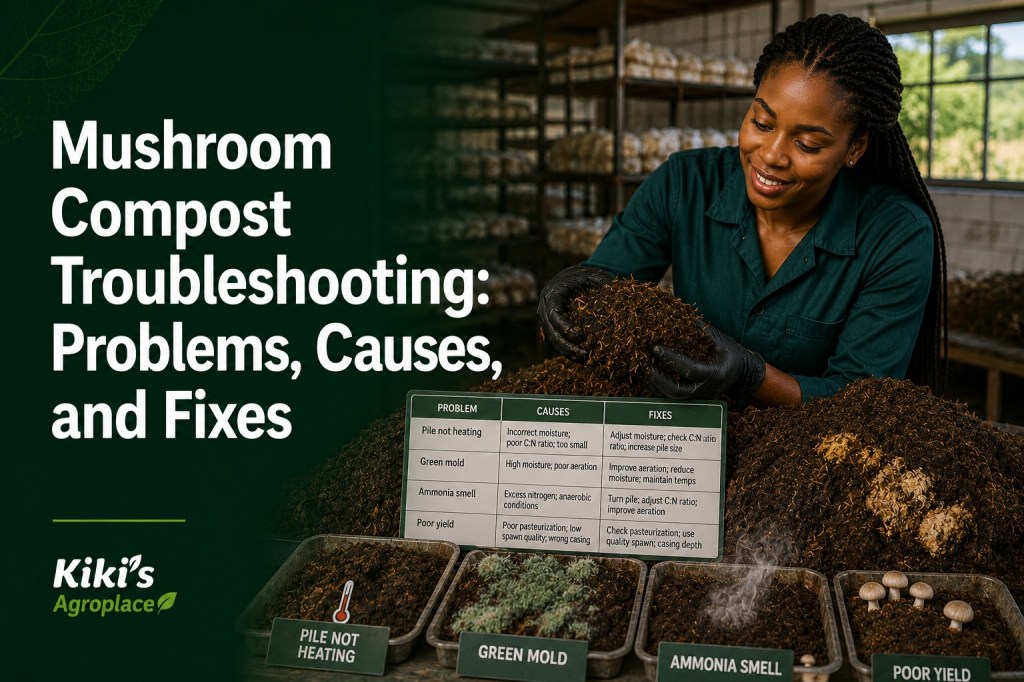
Something going wrong with your mushroom compost usually traces back to one of a handful of causes and most of them are fixable if you catch them early. This guide covers the most common problems across all three stages: building the pile (Phase I), pasteurizing it (Phase II), and spawning it. If you haven’t read our compost-making guide or bulk room guide yet, start there, this post assumes you’re already familiar with the basic process.
Problem: The Pile Won’t Heat Up (Phase I)
| Likely cause | Fix |
|---|---|
| Pile is too small | Build up to at least 3x3x3 feet (about 1 cubic meter). Below this size, the pile can’t hold enough heat to self-insulate. |
| Too dry | Add water until the material feels like a damp, wrung-out sponge — not dripping, not crumbly dry. |
| Too wet | Turn the pile to release trapped moisture and let air back in. Waterlogged compost goes anaerobic and stops heating. |
| Not enough manure (nitrogen) | Work in more manure. Straw alone is too carbon-heavy to heat up properly on its own. |
| Not enough oxygen | Turn the pile. A dense, unturned pile suffocates the microbes doing the actual heating. |
Problem: Green Mold Appears (Trichoderma)
Green, fluffy patches are almost always Trichoderma; a mold that outcompetes mushroom mycelium fast and is very hard to stop once established. It typically starts as white fluff (easy to mistake for healthy growth) before turning visibly green.
- Common causes: spawning compost while it’s still too hot (above 30°C kills mycelium and hands the compost to Trichoderma instead), incomplete pasteurization, old chicken manure (more than a month old lowers pH into Trichoderma’s favored range), wet anaerobic pockets in the pile, or an incorrect gypsum dose that lets the compost structure collapse.
- What to do: Remove and isolate any visibly green material immediately; it spreads fast and can take the rest of your batch with it. There’s no reliable way to save compost once Trichoderma has sporulated (turned green); prevention is the only real fix.
- Prevention: Cool compost fully to 25°C before spawning, use fresh manure, follow your gypsum ratio, and make sure the whole pile, not just the surface, hits pasteurization temperature.
How to identify good vs bad mushroom spawn.
Problem: Ammonia Smell Won’t Clear (Phase II)
This means the conditioning stage isn’t finished. Don’t spawn compost that still smells like ammonia; it’s toxic to mushroom mycelium and will kill your spawn outright.
- Fix: Keep the compost at 45-50°C and give it more time, up to 7 days if needed. Ammonia clears fastest in the 40-45°C range; if your compost is sitting hotter or cooler than that for the conditioning stage, it will take longer to clear.
- Don’t rush this. Spawning too early because you’re impatient is one of the most common reasons a whole batch fails after everything else went right.
Problem: Sour Smell or Slimy, Wet Patches
This points to bacterial contamination rather than mold. Thick yellow liquid pooling, combined with a sour or foul smell, is a clear warning sign, as opposed to normal moisture, which doesn’t smell bad.
- Cause: almost always excess moisture combined with poor airflow, the same wet, airless conditions that cause green mold, just a different organism taking advantage of it.
- Fix: Improve ventilation immediately and avoid overwatering going forward. Caught early, this can sometimes be managed; left alone, it spreads.
Problem: Grey, Wispy Mold (Cobweb Mold)
Cobweb mold looks like loose, grey, three-dimensional fuzz sitting above the surface, rather than the tight, rope-like white growth of healthy mycelium. It spreads quickly but is more manageable than Trichoderma if caught early, improving airflow and reducing humidity slightly can sometimes stop it before it takes over.
Problem: Spawn Isn’t Growing After Spawning
| Likely cause | Fix |
|---|---|
| Compost was still too hot when spawned | Always confirm compost has cooled to 25°C or below before adding spawn — check with a thermometer, not by feel. |
| Poor quality spawn | Good spawn smells earthy and fresh, looks white, and feels firm. Sour smell or green tinge means don’t use it — source from a reliable supplier. |
| Ammonia not fully cleared | Same issue as above — ammonia will prevent colonization even if the temperature was right. |
Problem: Poor Yield Even Though Nothing Looked Wrong
- Uneven supplement mixing. Nitrogen supplements need to be distributed evenly through the compost. Clumped supplement causes localized overheating that kills mycelium in that spot; areas with too little supplement simply underperform. Mix thoroughly, not just on top.
- Casing applied too early or too late. Casing before full colonization smothers the spawn; casing too late wastes time the spawn could have spent establishing further.
- Fruiting conditions off. Double-check temperature and humidity match what’s needed at the fruiting stage, not just during spawn run; these are different targets.
How to make mushroom grain spawn.
Quick Reference
| What you see | Likely stage | Likely cause |
|---|---|---|
| Pile stays cool, no heat | Phase I | Too small, too dry/wet, or not enough manure |
| Green fluffy patches | Phase I, II, or spawning | Trichoderma — usually a pasteurization or timing failure |
| Ammonia smell persists | Phase II | Conditioning stage incomplete — needs more time |
| Sour smell, slimy, yellow liquid | Any stage | Bacterial contamination from excess moisture and poor airflow |
| Grey wispy growth above surface | Any stage | Cobweb mold — improve airflow, reduce humidity slightly |
| No mycelium after spawning | Spawning | Compost too hot when spawned, or poor spawn quality |
| Low yield, no visible problem | Spawning through fruiting | Uneven supplement mixing or casing timing |
When to Start Over vs. When to Salvage
Trichoderma once it’s visibly green: start over, and isolate the contaminated material away from your working area. Bacterial contamination or cobweb mold caught early: often salvageable with better airflow and less moisture going forward. When in doubt, trust your nose; healthy compost smells earthy, not sour or ammonia-heavy.
Key Takeaways
- Most compost problems trace back to moisture, airflow, or timing; not bad luck.
- Green mold (Trichoderma) is close to impossible to salvage once visible; prevention matters more than a cure here.
- Never spawn compost while it’s hot or still smells like ammonia, even if you’re behind schedule.
- Low yield with no visible problem is often a mixing or timing issue, not a mystery.
FAQ
Can I fix compost once it has green mold?
Not reliably. Once Trichoderma has turned visibly green, it’s already spreading spores. Remove and isolate it, and focus on prevention for your next batch.
My compost smells fine but my yield was still low — what happened?
Check how evenly your nitrogen supplement was mixed in, and whether casing was applied at the right time. Both cause yield problems without any obvious warning signs.
Is a bad smell always a sign of failure?
An ammonia smell before conditioning is finished is normal; it should clear with time. A sour or rotten smell, on the other hand, usually signals bacterial contamination and is a real warning sign.


Leave a Reply