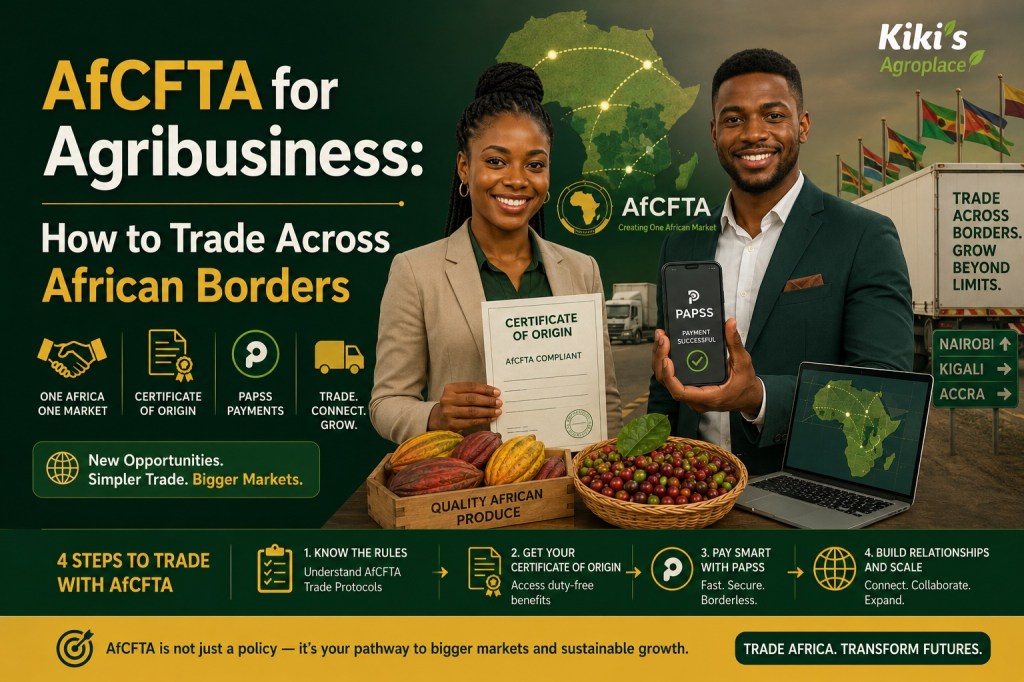
AfCFTA is opening up trade across Africa, and most agribusiness owners haven’t touched it yet. If you sell farm produce, processed food, or agricultural products to buyers in other African countries, AfCFTA can cut your costs and speed up your payments. Here’s what it actually changes, and how to start using it.
What is AfCFTA?
AfCFTA stands for African Continental Free Trade Area. It’s an agreement between 54 of Africa’s 55 countries to trade with each other more easily.
The plan is simple: remove tariffs on most goods traded between African countries, and make it easier to sell your product across borders without getting stuck in paperwork or losing money to fees.
How to export farm products (beginner’s guide)
What AfCFTA actually changes for you
| Before AfCFTA | Under AfCFTA |
| High tariffs at nearly every border | Tariffs removed on 90% of goods, phased in over time |
| Payments sent through foreign banks in USD or EUR, slow and costly | Local currency payments through PAPSS, often settled in minutes |
| No shared proof-of-origin document | One Certificate of Origin, recognized across the continent |
| Different customs rules in every country | Shared rules of origin agreed across all member countries |
Agri-food processing already makes up close to half of all trade happening between African countries, and that share keeps growing. Farm produce and processed food are exactly what this agreement is built to move.
The Certificate of Origin — your ticket to lower tariffs
A Certificate of Origin proves your product was grown or made in an AfCFTA country. Without it, your buyer pays full tariffs. With it, they pay little or nothing.
- Contact your country’s designated authority, usually your Chamber of Commerce or a government trade office.
- Show that your product meets the origin rules. This means it was either fully grown or made in Africa, or processed enough there to count.
- Submit supporting documents: invoices and records showing where your materials or ingredients came from.
- Receive your certificate. It’s valid for 12 months.
- If you export often, ask about “approved exporter” status. This lets you skip applying for a new certificate every time you ship.
How to package and brand your farm products to sell at higher rates
PAPSS — get paid in your own currency
PAPSS stands for Pan-African Payment and Settlement System. It lets you pay and get paid in your own currency, without routing the money through a foreign bank first.
Here’s how a payment moves through it:
- You send a payment instruction to your bank, in your own currency.
- Your bank sends it to PAPSS through your country’s central bank.
- PAPSS checks the details and forwards it to the buyer’s bank.
- The money lands in the buyer’s account in their own currency, often within minutes.
PAPSS is already connected to over 160 commercial banks. As of early 2026, it’s live in Nigeria, Ghana, Sierra Leone, Liberia, Gambia, Zimbabwe, Guinea, Djibouti, Kenya, Zambia, Rwanda, and Malawi, with more countries joining. Ask your bank if you’re connected, many banks add this quietly, without telling customers.
Export documentation basics for agricultural products
Common myths about AfCFTA
Myth: “AfCFTA means zero tariffs everywhere, right away.”
Reality: tariffs are being removed gradually, on 90% of goods. It’s not instant and it doesn’t cover everything.
Myth: “This is only for big exporters.”
Reality: small agribusinesses and cooperatives can apply for a Certificate of Origin and use PAPSS too. You don’t need to be a large company.
Myth: “My country hasn’t joined yet.”
Reality: 54 of 55 African Union countries have signed on. What varies is how fast each country’s banks and customs offices have gone live, check your local status rather than assuming you’re excluded.
Steps to take now
- Check if your customs office issues AfCFTA Certificates of Origin yet. Most major economies already do.
- Ask your bank if it’s connected to PAPSS. If not, ask when it plans to connect.
- Find your product’s origin rule. Some products just need to be grown or made in Africa. Others need a set share of local processing.
- Apply for approved exporter status if you export regularly, it saves you paperwork on every shipment.
- Watch for Guided Trade Initiative news in your country. It’s already matching real buyers and sellers ahead of full rollout.
Finding buyers and distributors abroad for agricultural exports
FAQ
Does AfCFTA remove all tariffs immediately?
No. Tariffs are being phased out over time, covering 90% of goods. Some products move faster than others.
Can a small agribusiness use AfCFTA, or is it only for big exporters?
Small agribusinesses and cooperatives can use it. You apply for a Certificate of Origin the same way a large company does, and PAPSS is open to businesses of any size that bank with a connected institution.
What is a Certificate of Origin and do I need one?
It’s a document proving your product was grown or made in Africa. You need one to get lower tariffs when your buyer imports it into another AfCFTA country.
Is PAPSS available in my country yet?
As of early 2026, it’s live in Nigeria, Ghana, Sierra Leone, Liberia, Gambia, Zimbabwe, Guinea, Djibouti, Kenya, Zambia, Rwanda, and Malawi. More countries are joining. Check with your bank directly, since coverage keeps expanding.
What if my country hasn’t fully joined AfCFTA yet?
54 of 55 African Union countries have signed the agreement. If you’re unsure of your country’s rollout status, ask your local trade ministry or Chamber of Commerce directly.
Does AfCFTA cover farm produce, or just manufactured goods?
It covers farm produce and processed food too. Agri-food processing already makes up close to half of all trade happening between African countries under this agreement.
Key takeaways
- AfCFTA is live in 54 of 55 African countries, aiming to remove tariffs on 90% of goods traded between them.
- A Certificate of Origin proves your product qualifies for lower tariffs, and small businesses can apply for one.
- PAPSS lets you get paid in your own currency, often within minutes, without routing through a foreign bank.
- Farm produce and processed food are a growing share of what’s traded under this agreement.
- Rollout speed differs by country. Check your local customs office and bank directly rather than assuming you’re not covered.
Not sure where your business stands on AfCFTA readiness? Get in touch for a free trade readiness chat.


Leave a Reply