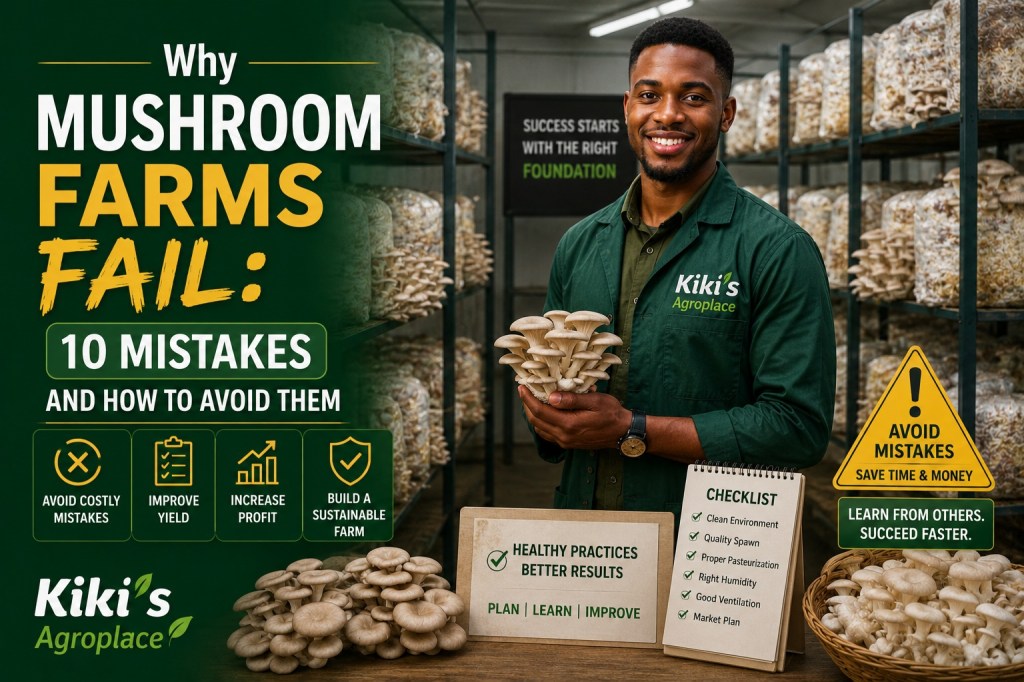
Most new mushroom farms do not fail because mushroom farming is difficult. They fail because of a small, repeatable set of mistakes: the same ones, made over and over, by beginners in Nigeria, the US, the UK, and everywhere mushrooms are grown. Understanding why mushroom farms fail before you start, or before your next batch, is the fastest way to avoid joining that statistic.
This guide walks through the ten most common reasons mushroom farms fail, most rooted in technical contamination problems, others in business and planning gaps that are just as fatal to a farm’s survival. If you are starting out, treat this as a pre-launch checklist. If you are already farming and something keeps going wrong, you will likely find your problem here.
Table of Contents
1. The truth about mushroom farm failure rates
2. Mistake 1 — Skipping sterilization or cutting corners on it
3. Mistake 2 — Starting too big, too fast
4. Mistake 3 — Underestimating startup and running costs
5. Mistake 4 — Picking the wrong species to start with
6. Mistake 5 — Poor substrate preparation
7. Mistake 6 — Rushing the process and interfering too early
8. Mistake 7 — Wrong environment for your species
9. Mistake 8 — No market research before production
10. Mistake 9 — No business plan or financial tracking
11. Mistake 10 — Trying to do everything alone, with no mentorship
12. A simple pre-launch checklist to avoid these mistakes
13. Key takeaways
14. FAQ
1. The Truth About Mushroom Farm Failure Rates
Mushroom farming has a steep early learning curve, and a significant share of new operations do not survive their first year. The reasons are consistent across markets: contamination losses, underestimated costs, poor market planning, and rushed scaling.
In Nigeria, mushroom farming carries strong upside, the country imports most of the mushrooms it consumes, leaving room for local producers to fill that gap. But that opportunity has not translated into uniform success. The farms that survive past year one treat mushroom farming as both a technical skill and a business discipline, not just one or the other.
2. Mistake 1 — Skipping Sterilization or Cutting Corners on It
This is the single biggest cause of mushroom farm failure. Contamination: green mold, bacterial wet spot, competing fungi is what most new growers eventually point to when their batch fails, and almost every case traces back to a sterilization or hygiene gap.
Why it happens: New farmers underestimate how aggressively other microorganisms compete with mushroom mycelium. The same warm, moist, nutrient-rich environment that mushrooms need is equally ideal for mold and bacteria. A single contaminant spore landing in your substrate at the wrong moment can take over an entire batch.
What it looks like: Green, black, or pink fuzzy growth on your substrate. A sour or rotten smell. Slimy, discoloured patches spreading across what should be clean white mycelium.
How to pasteurize mushroom substrates (complete beginner’s guide)
How to avoid it:
- Treat every surface, tool, and container as a contamination risk until proven otherwise. Wipe down with alcohol before any work begins.
- Fully sterilize or pasteurize your substrate using one proven method. Do not mix techniques or shortcuts from different sources.
- Work in a clean, still-air environment during inoculation. A simple still-air box is a low-cost, effective option for smaller operations.
- Let substrate cool fully to room temperature before inoculating. Adding spawn to hot substrate kills it and invites contamination.
- Never open sealed bags or jars to “check on progress” during colonization. Every opening is a new contamination opportunity.
3. Mistake 2 — Starting Too Big, Too Fast
New mushroom farmers often want to scale immediately, building a large operation before they have proven they can manage a small one.
Why it happens: It’s tempting to assume mushroom farming scales in a straight line; that doubling your bags doubles your output at the same difficulty. In reality, scaling brings new problems: airflow gets harder to control across a larger space, contamination spreads faster, and labour needs grow faster than most new farmers expect.
What it looks like: A farmer who jumps straight to 500 bags before ever completing a 50-bag cycle. A major contamination event at that scale isn’t a setback; it can end the business.
Complete step by step guide on how to grow mushrooms for beginners.
How to avoid it:
- Start small. Running several complete cycles at a manageable scale: 50 to 100 bags is a reasonable Nigerian starting point, before expanding.
- Treat your first few cycles as a learning period, not a profit period. Mistakes at small scale cost you a batch. Mistakes at large scale can cost you the business.
- Scale only when demand consistently outpaces your supply, and once you know exactly where your bottlenecks are.
4. Mistake 3 — Underestimating Startup and Running Costs
A surprising number of new mushroom farms run into money trouble not because the farm fails technically, but because the farmer runs out of cash before reaching steady profit.
Why it happens: Beginners budget for spawn and substrate but forget packaging, marketing, transport, labour, and the working capital needed to survive the weeks between batches before steady income builds. Equipment costs, even basic climate control, get underestimated too.
What it looks like: A farmer who spends most of their budget on infrastructure, leaving nothing for packaging, marketing, or the first few months of running costs before sales become steady.
Mushroom farming business plan.
How to avoid it:
- Build a full cost breakdown before you start: inputs, packaging, transport, labour, marketing, and a buffer for at least two full cycles of running costs.
- Know your break-even point: how many kilograms you need to sell, at what price, to cover monthly running costs.
- Resist spending your entire budget on infrastructure. A modest setup with money left for marketing beats an impressive setup with nothing left to sell from.
5. Mistake 4 — Picking the Wrong Species to Start With
Some beginners chase high-value, exotic mushroom species before mastering the basics and pay for it in lost batches and wasted money.
Why it happens: Specialty species often command higher prices, which makes them attractive on paper. But many need specific growing conditions, longer production cycles, or specialised knowledge a first-time grower doesn’t have yet.
What it looks like: A new farmer attempting a demanding species without the experience or contacts to manage its requirements, resulting in repeated failed batches and an exhausted budget before any product reaches market.
How to avoid it:
- Start with oyster mushrooms. They forgive minor mistakes, grow on a wide range of substrates, have strong demand, and give you fast feedback to learn from.
- Master one species and one method completely before adding others. Build your skills and buyer base on something resilient first.
6. Mistake 5 — Poor Substrate Preparation
Substrate problems sit at the root of many contamination and growth failures, but they’re distinct enough from general sterilization mistakes to call out separately.
Why it happens: Contaminated raw materials, the wrong substrate density, poor moisture levels, or skipping pH adjustment all compromise the substrate before the mushroom gets a chance to grow.
What it looks like: Substrate that’s too wet, inviting bacterial growth. Substrate that’s too dry, slowing colonization and leaving it open to contaminants. Substrate made from poor-quality or contaminated raw materials that introduce pathogens from the start.
How to identify good or bad mushroom spawn
How to avoid it:
- Test your substrate moisture by squeezing a handful firmly; it should feel damp, not dripping, and not dry or dusty.
- Use the correct spawn-to-substrate ratio for your species. Too little spawn slows colonization and invites contamination; too much can cause overheating.
- Source clean, high-quality raw materials. Cutting cost corners on substrate inputs is one of the most expensive mistakes you can make, because it compromises the entire batch from the start.
7. Mistake 6 — Rushing the Process and Interfering Too Early
Mushroom farming punishes impatience. New growers consistently move to the next stage before the current one is actually finished.
Why it happens: Eagerness to see results leads new farmers to open bags early to check progress, introduce fresh air too soon to trigger fruiting, or harvest before mushrooms have matured.
What it looks like: Opening a colonizing bag “just to check,” which introduces contamination at a vulnerable stage. Triggering fruiting before the substrate is fully colonized, causing low yields or contamination breaking through a weak mycelial network. Harvesting too early, producing small, underdeveloped mushrooms; or too late, letting them release spores and lose quality.
How to avoid it:
- Know the realistic colonization timeline for your species and trust the process. Oyster mushrooms colonize fairly quickly; other species take much longer.
- Wait until colonization is fully complete; dense, uniform white mycelium throughout the substrate, before introducing fruiting conditions.
- Harvest at the right window: when caps begin to open but haven’t fully flattened.
8. Mistake 7 — Wrong Environment for Your Species
Every mushroom species has specific needs for temperature, humidity, and airflow. Getting these wrong stunts growth even when sterilization and substrate prep were done right.
Why it happens: New farmers often copy a setup they saw online without adjusting it for their local climate, their species, or their growing space.
What it looks like: Stunted, deformed mushrooms from poor ventilation and CO2 buildup. Slow or stalled mycelium growth from low or fluctuating temperatures. Excess moisture combined with poor airflow, favouring bacteria over mycelium.
How to avoid it:
- Research the specific temperature, humidity, and airflow needs for your chosen species before you start. Don’t assume one setup works for every mushroom type.
- Build in ventilation from the start. Mushrooms need fresh air exchange to prevent CO2 buildup, even though they also need humidity.
- Monitor your growing environment consistently, not just at setup. Conditions drift, especially in Nigeria’s variable climate, and small shifts compound into failed batches if you don’t catch them.
9. Mistake 8 — No Market Research Before Production
A technically perfect harvest is worthless if nobody’s ready to buy it. This is one of the most overlooked causes of mushroom farm failure; the farming goes right, the business goes wrong.
Why it happens: Aspiring mushroom farmers often jump straight into production, focused on the growing process, without confirming there’s real, accessible demand for what they’re about to produce.
What it looks like: A farmer who produces a healthy harvest and only then starts looking for buyers, discovering too late that local demand is thinner than expected, nearby restaurants already have a supplier, or consumers in their area don’t know mushrooms as food.
How to avoid it:
- Visit potential buyers; restaurants, hotels, caterers, market vendors, before your first harvest, not after. Offer samples and gauge interest two to three weeks ahead of your harvest date.
- Set up a WhatsApp Business presence and start building an audience while your first batch is still growing.
- Confirm pricing with real buyers in your area rather than assuming generic figures. Fresh oyster mushroom prices in Nigeria vary by city and buyer type.
10. Mistake 9 — No Business Plan or Financial Tracking
Mushroom farms that fail for business reasons rather than technical ones almost always share the same root cause: no real plan and no tracking of the numbers that determine survival.
Why it happens: The technical excitement of growing mushrooms often overshadows the unglamorous business work: costing, pricing, tracking, and forecasting that decides whether a farm becomes a sustainable business or an expensive hobby.
What it looks like: A farmer who can’t say with confidence what their cost per kilogram is, what their break-even volume is, or whether last month’s harvest was actually profitable once every cost is counted.
How to avoid it:
- Write a simple business plan before you start. It doesn’t need to be long, but it needs to cover your costs, your market, and your production process honestly. Read our guide on how to write a farm business plan that gets you funded for a full template.
- Track every cost against every harvest. Know your cost per kilogram, your break-even volume, and your actual margin after every cycle.
- Review your numbers after every batch, not just at year end. Small inefficiencies compound quickly in a business with thin per-unit margins.
11. Mistake 10 — Trying to Do Everything Alone, With No Mentorship
Many failed mushroom farms share one final, less technical mistake: the farmer tried to learn everything from scratch, alone, without seeking out anyone who had already solved the problems they were about to face.
Why it happens: Mushroom farming information online is abundant but inconsistent. Different sources recommend different techniques, and beginners often combine pieces from several sources without understanding why each step matters, leading to avoidable mistakes.
What it looks like: A farmer repeating the same contamination mistake for several cycles in a row because they have no one to diagnose the actual cause. A farmer who could have avoided months of trial and error with a single conversation with an experienced grower.
How to avoid it:
- Seek out training or mentorship from an experienced mushroom farmer before you start, even informally. A single conversation can save months of repeated mistakes.
- Pick one proven technique and follow it completely rather than combining advice from many different sources.
- Join or build a community of other mushroom farmers. Shared experience shortens everyone’s learning curve and catches mistakes before they get expensive.
12. A Simple Pre-Launch Checklist to Avoid These Mistakes
Before you start your next batch or your first one run through this list:
| Check | Status |
|---|---|
| Sterilization method is consistent and proven, not improvised | ☐ |
| Starting scale is small enough to absorb a failed batch without ending the business | ☐ |
| Full cost breakdown completed, including packaging, marketing, and a running cost buffer | ☐ |
| Starting species is oyster mushroom or another beginner-resilient variety | ☐ |
| Substrate sourced from clean, quality raw materials with correct moisture tested | ☐ |
| Colonization and fruiting timelines understood and will not be rushed | ☐ |
| Growing environment researched and matched to the specific species | ☐ |
| At least three potential buyers contacted before harvest, with samples offered | ☐ |
| Simple business plan written, covering costs, market, and production process | ☐ |
| A mentor, course, or experienced grower contact identified for troubleshooting | ☐ |
13. Key Takeaways
- Sterilization is the single biggest point of failure. Treat every surface and tool as contaminated until proven otherwise.
- Start small and prove one full cycle before scaling. A failed batch at small scale is a lesson; a failed batch at large scale can be the end of the business.
- Budget for the whole picture: packaging, marketing, and a running-cost buffer, not just spawn and substrate.
- Start with oyster mushrooms before chasing higher-value specialty species.
- Substrate quality and correct moisture prevent most contamination and growth problems before they start.
- Patience matters. Rushing colonization or harvest costs you yield and quality every time.
- Match your growing environment to your species, and keep monitoring it, not just at setup.
- Confirm real buyers exist before your harvest, not after.
- Track your numbers every cycle. A farm survives on business discipline as much as growing skill.
- Find a mentor or community. Most mistakes you’ll make have already been solved by someone else.
14. FAQ
What are the major problems in mushroom cultivation?
Contamination from poor sterilization is the biggest one, followed by rushed scaling, underestimated costs, wrong species choice for a beginner, and skipping market research before production. All ten are covered in detail above.
Is being a mushroom farmer worth it?
For many growers, yes, especially where demand outpaces local supply, as it does in much of Africa. But it rewards farmers who treat it as a real business, not just a growing hobby. The farms that struggle are usually the ones missing a business plan, not the ones missing growing skill.
Is it difficult to become a mushroom farmer?
The learning curve is real but manageable. Oyster mushrooms specifically are forgiving enough for a genuine beginner to succeed with, provided sterilization and substrate prep are done properly.
Do mushroom farmers make a lot of money?
It varies hugely by scale, species, and market access. A small oyster mushroom setup can be profitable but modest; a well-run operation targeting specialty species like lion’s mane or shiitake, where prices run higher, can be considerably more so once it’s established.
What is the most profitable mushroom to farm?
Lion’s mane and shiitake generally command a real premium over oyster and button mushrooms. See our lion’s mane and shiitake market posts for real pricing.
How much would it cost to start a mushroom farm?
This ranges enormously. A small oyster mushroom setup (50 to 100 bags) can start with a modest budget covering spawn, substrate bags, and basic tools. A medium-sized commercial operation with proper compost and climate control facilities can run into tens of thousands of dollars. Start small and scale from there rather than assuming you need the larger figure upfront.
How hard is it to start a mushroom farm?
Getting started is genuinely accessible, especially with oyster mushrooms. What’s hard is surviving past the first year, which comes down to avoiding the ten mistakes covered in this guide, not the initial setup itself.
Which mushroom is in high demand?
Depends on your market. Oyster and button mushrooms have the broadest general demand; shiitake and lion’s mane lead in specialty and wellness markets. See our species selection guide for a full comparison.
Is there a shiitake mushroom shortage?
Not a global shortage exactly, but real regional supply gaps do exist. Some African countries currently import a large share of the shiitake they consume rather than growing it locally, which is more of an opportunity for local producers than a true shortage. See our shiitake market post for the specific numbers.
What is the best tasting mushroom to eat?
This comes down to preference, but shiitake is widely regarded for its rich, savory flavor, and lion’s mane is often compared to seafood or crab meat for its texture. Oyster and button mushrooms are milder and more versatile in everyday cooking.
Why do mushroom farms smell bad?
It’s not the mushrooms themselves, it’s the compost. Farms that use manure-based compost (the method used for button mushrooms) produce hydrogen sulfide and ammonia during the composting process, which is what causes the odor complaints associated with mushroom farms. Substrate-based methods that don’t use manure, like those used for oyster mushrooms, don’t have this problem.
Why does Kennett Square smell so bad?
Kennett Square, Pennsylvania is known as the mushroom capital of the US, and its concentration of manure-based composting facilities has led to well-documented odor complaints from nearby residents, with independent air quality studies confirming elevated hydrogen sulfide levels near these sites. It’s the same underlying cause as any manure-based mushroom compost operation, just concentrated in one area with a lot of production.


Leave a Reply